Spend you cannot classify is spend you cannot manage
Ask a CPO “how much do we spend on logistics, globally?” and in most companies the honest answer is “give us three weeks.” The data exists in every PO and invoice line, but nobody can reliably say what each transaction is for. That classification gap is where savings, maverick suppliers and risk all hide at once. This book is the complete method for closing it with GenAI.
What makes this the most comprehensive work on the subject
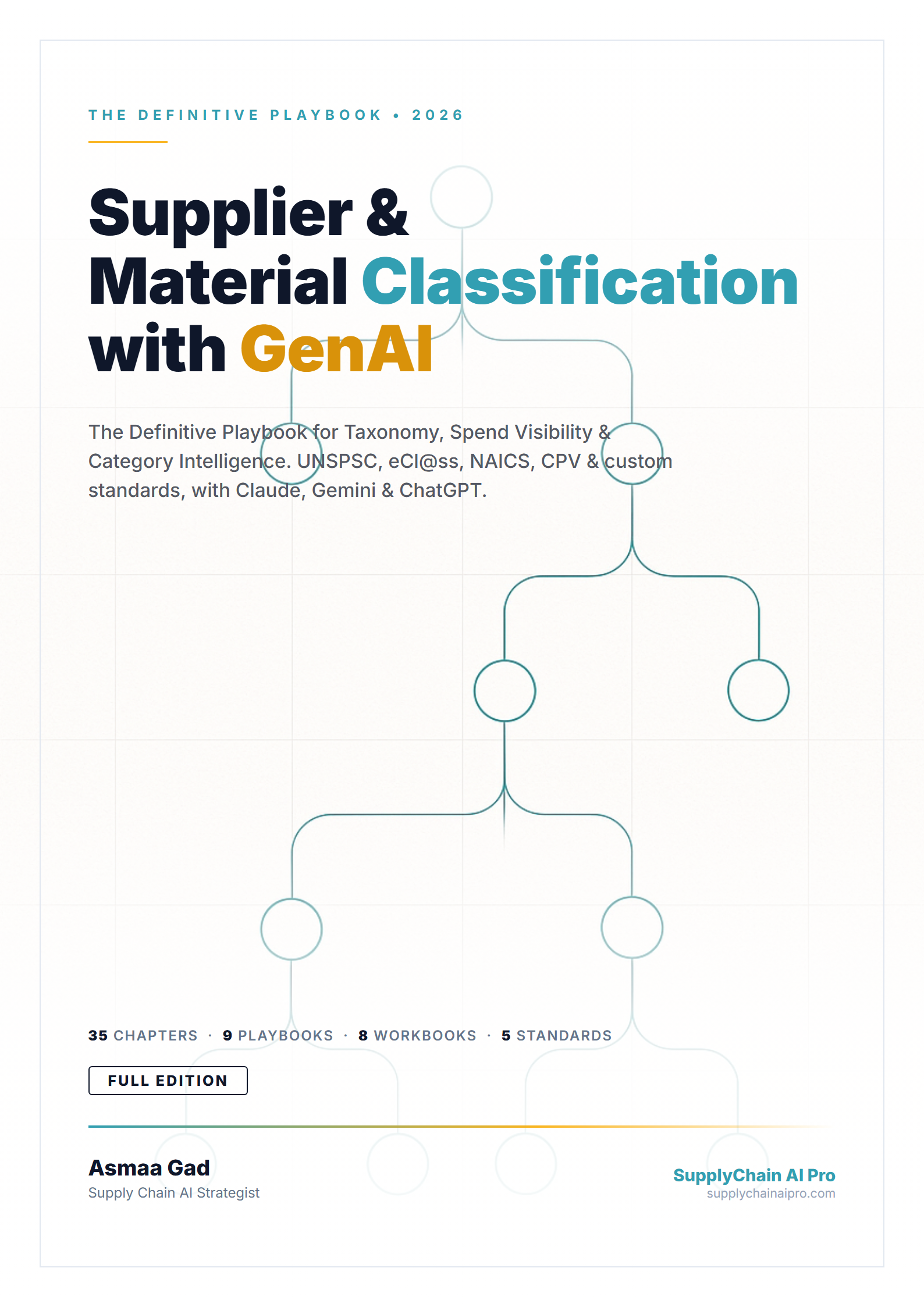
- All five standards in one place: UNSPSC (spend), eCl@ss (materials and attributes), NAICS/NACE (suppliers), CPV/HS (public procurement and trade), and how to design a custom corporate taxonomy.
- 9 step-by-step playbooks run end to end against a real, deliberately messy 2,500-row spend dataset: clean and normalize, auto-classify to UNSPSC, classify materials to eCl@ss with attributes, segment suppliers to NAICS, build a spend cube, tame tail and maverick spend, design a custom taxonomy, crosswalk between standards, and keep it all clean over time.
- 5 cross-industry case studies: manufacturing, indirect and services, retail and CPG, public sector, and an M&A taxonomy harmonization.
- The full GenAI method: prompt engineering for classification, RAG and embeddings for 150,000-code taxonomies, agents and pipelines, and the governance that keeps accuracy defensible and auditable.
- 62-prompt library plus 6 reference appendices.
Your download includes
- The Full Edition PDF, 496 pages, 35 chapters and 6 appendices
- Master_Spend_Dataset.xlsx (2,500 transactions, the working file for every playbook)
- Seven derived workbooks: UNSPSC classified output, eCl@ss material master, supplier master with NAICS, crosswalk mapping, custom taxonomy builder, classification scorecard, and the prompt library
Who it is for
Procurement analysts and category managers, spend-analytics and master-data teams, CPOs and supply chain leaders, and consultants who want to turn a messy spend file into clean, defensible classification in days rather than months.
All datasets are synthetic and illustrative, built for training. Written by Asmaa Gad for SupplyChain AI Pro.